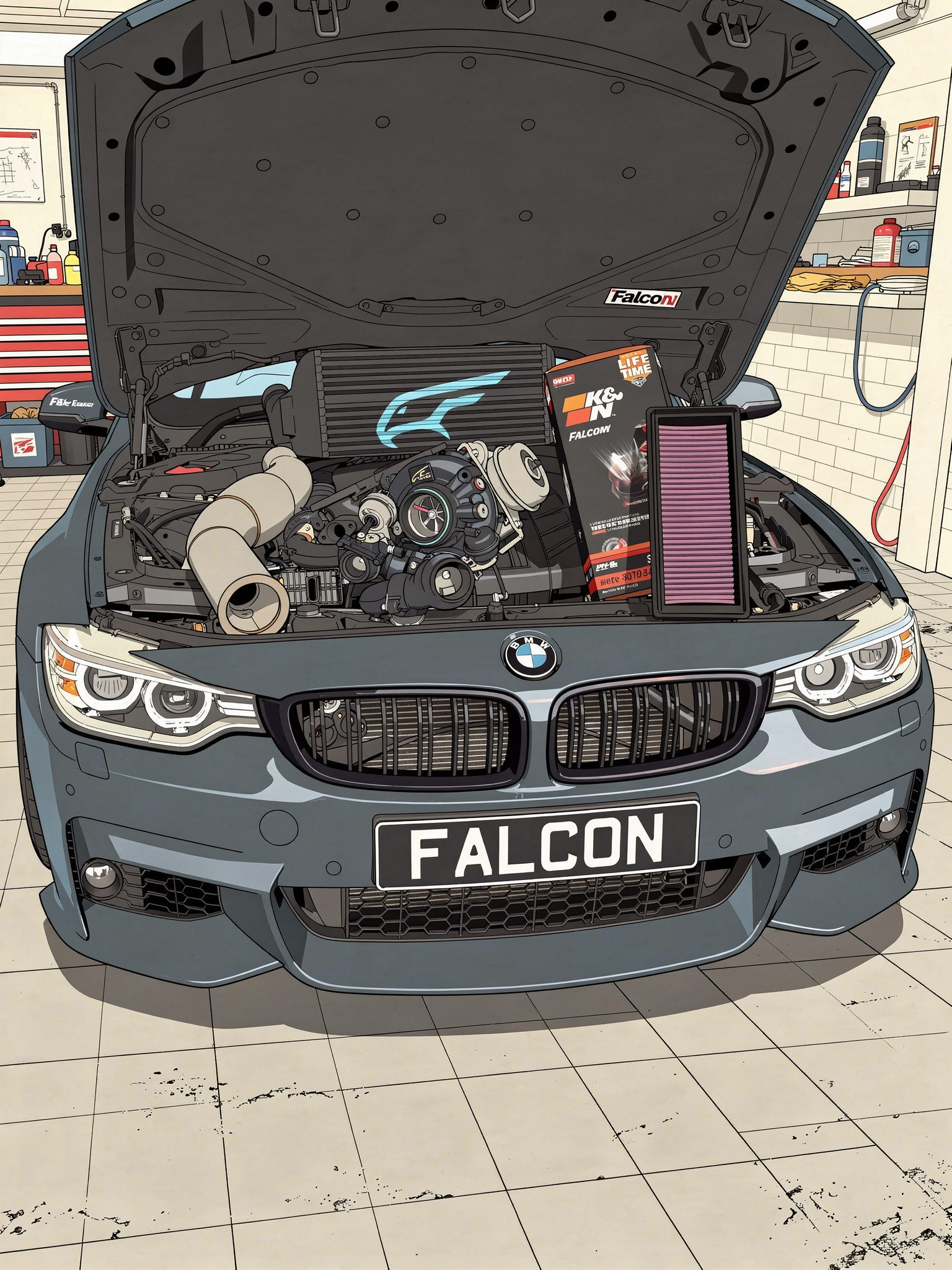
Falcon Turbos BMW N57 hybrid turbo setup

BMW 335d hybrid turbos and modifications

BMW 435d and 335d hybrid turbos and modifications

The BMW N57D30T1 twin-turbo engine fitted to the F30 335d and F32/F36 435d xDrive represents one of the most capable diesel platforms ever built. Delivering 313 PS (309 bhp) and 630 Nm of torque in factory trim, it blends everyday drivability with relentless low-down pull. The BMW F3# chassis 35d models come alive with the right modifications. 335d hybrid turbos and modifications transform the daily diesel into a serious performer.  

Underneath the stock calibration lies an over-engineered aluminium block, robust forged internals, and an advanced sequential bi-turbo system ready to deliver substantial power gains.

What Holds the N57 Back in Factory Form?

While the engine is exceptionally robust and reliable, the factory package hits thermal, gas-flow, and volumetric bottlenecks early when pushed beyond a basic Stage 1 software remap.

  • Exhaust Backpressure & DPF Restriction: The OEM Diesel Particulate Filter (DPF) and factory catalytic converter create significant backpressure immediately downstream of the turbine housings. Under continuous load at higher boost targets, exhaust gas temperatures (EGTs) climb rapidly, prompting the ECU to apply thermal fuel trims.
  • Thermal Soak from the Stock Intercooler: The standard tube-and-fin front-mount intercooler is engineered for stock boost profiles. Push past 360–380 bhp, and inlet air temperatures (IATs) spike quickly during wide-open throttle pulls, causing ignition timing advance retraction and density loss.
  • Factory Turbo Airflow Ceiling: The sequential turbocharger assembly uses a responsive high-pressure (HP) turbo to spool instantly off idle, seamlessly transitioning into a larger low-pressure (LP) turbo. Past ~380–390 bhp, the factory LP compressor wheel runs out of efficiency, blowing hot, compressed air while exhaust manifold backpressure spikes sharply.
  • Fuel Flow & High-Pressure Rail Limits: The factory Bosch CP4.2 high-pressure fuel pump and rail assembly adequately sustain mid-range torque, but at extended RPM targets and higher boost pressures, rail pressure starts to drop, starving the engine of clean atomised diesel when aiming beyond 480 bhp.

Unlocking the Platform: Stage-by-Stage Hardware Upgrade Pathways

To move past the limits of factory software, the hardware chain must address breathing, cooling, and fuelling sequentially.

Hardware Configuration Supporting Modifications Expected Output Characteristics
DPF-Retained Hybrid Setup Falcon Turbos 335d 435d Hybrid Turbos, Stock Intercooler, High-Flow Air Filter  ~420 HP Fast spool, clean emissions profile, high mid-range torque
Full Flow & Thermal Upgrade Falcon Turbos Hybrids, 3.5” Stainless Downpipe, Performance FMIC ~485 HP Drastically reduced EGTs, sustained top-end pull, razor-sharp transient response
Pushing Past 500 Limit Fuelling Build Falcon Hybrids, 3.5” Downpipe, FMIC, Upgraded HPFP Shaft & Fuel Rail 500+ HP / 900+ Nm High-pressure diesel delivery sustained to redline, maximum volumetric efficiency

Key Upgrade Components

  1. Falcon Turbos N57 Hybrid Turbochargers Upgrading both the high-pressure and low-pressure turbochargers changes the breathing dynamic entirely. With re-profiled compressor housings, larger billet compressor wheels, and high-flow, heat-resistant turbine shafts, backpressure drops while airflow volume increases dramatically across the entire rev band. The hybrid setup preserves instant low-rpm boost response while pulling hard past 4,500 RPM.
  2. 3.5” High-Flow Downpipe Replacing the standard emissions bottleneck with a mandrel-bent 3.5” downpipe eliminates high turbine backpressure. Removing this restriction drops EGTs significantly, protects turbocharger bearings from excessive heat soak, and allows tuners to command leaner, more aggressive spool-up timing.
  3. Stepped Front Mount Intercooler (FMIC) Increasing core depth and frontal surface area keeps IATs stable within single digits of ambient temperatures, even across repeated 1/4-mile passes or continuous high-speed runs. Denser, cooler charge air directly improves burn efficiency and combustion chamber pressure without over-spinning the compressor.
  4. High-Pressure Fuelling Overhauls (500+ HP Target) Once air mass flow is unlocked, the fuel delivery system must match it. Upgrading the high-pressure fuel pump drive/shaft mechanism alongside enlarged fuel rail delivery channels prevents rail pressure sag under high-duration injection events. This delivers the necessary fuel mass for clean, smoke-free combustion right to redline.

With the right balance of hybrid turbocharger engineering, reduced exhaust backpressure, efficient charge cooling, and reinforced fuelling, the 335d and 435d transform from smooth motorway cruisers into legitimate supercar-hunting diesels capable of consistent 4-second and sub-4-second 0–60 mph launches via xDrive. Read more about the M4 Challenger F32 435d built by Falcon Turbos.

Contact us the team today if you have any questions about unlocking the full potential of your N57 BMW 335d or 435d with high-performance upgrade turbos and parts from Falcon Turbos.

Different stage hybrid turbos explained by Falcon Turbos

Differences between a BCW, Stage 1, 2 and 3 Hybrid Turbo

What is the difference between a BCW, Stage 1, Stage 2 and Stage 3 Hybrid Turbo?

Upgrading your turbocharger is one of the most effective ways to extract serious performance from your vehicle, but navigating the terminology can be confusing. At Falcon Turbos, we re-engineer turbochargers to be stronger, more efficient, and more reliable than OEM units using our proprietary performance components, upgraded bearing systems, lightweight billet compressor wheels, and high-flow shafts.

To help you choose the right setup for your power goals and hardware, here is a breakdown of the different types of hybrid turbos we offer and the main differences between our BCW, Stage 1, Stage 2, and Stage 3 builds.

BCW (Billet Compressor Wheel) Upgrades

BCW units are direct replacements for factory turbochargers. By replacing the standard cast wheel with a CNC-machined lightweight billet compressor wheel, these units deliver sharper transient response, quicker spool, and improved airflow without altering the factory footprint.

  • Supporting Hardware: None required; runs with entirely stock hardware.
  • Software/Mapping: Operates safely on a stock ECU map or a mild Stage 1 remap.
  • Best For: Drivers looking for the safest, most reliable drop-in upgrade for a noticeable bump in power and throttle response without modifying any other engine components.

Stage 1 Hybrid Turbos

A Stage 1 hybrid is a mild performance upgrade engineered to optimise airflow while retaining the vehicle’s standard engine setup. These units typically feature re-profiled compressor geometry and uprated internal bearings to handle slightly elevated boost pressures efficiently.

  • Supporting Hardware: Compatible with standard engine components; upgraded intake or panel filter recommended.
  • Software/Mapping: Designed specifically to work in conjunction with an ECU remap to unlock extra power.
  • Best For: Everyday road cars wanting a solid jump in mid-range torque and peak power without investing in extensive hardware modifications.

Stage 2 Hybrid Turbos

Stage 2 units are built for enthusiasts demanding significantly higher airflow and sustained top-end pull. These turbos feature larger, CNC-profiled compressor wheels, clipped or upgraded turbine shafts to reduce backpressure, and heavy-duty 360-degree thrust bearings to withstand higher boost levels.

  • Supporting Hardware: Must have supporting modifications. Benefits significantly from a larger front-mount intercooler, uprated downpipe (high-flow sports cat or decat), and an upgraded intake tract.
  • Software/Mapping: Mandatory remap required before driving. The engine management must be calibrated immediately to match the substantial increase in air volume and avoid lean conditions.
  • Best For: Fast-road and track vehicles aiming for significant power increases while retaining a bolt-on OEM-style footprint.

Stage 3 Hybrid Turbos

Stage 3 represents the pinnacle of hybrid turbo engineering, pushing the original housings to their absolute mechanical limits. These hybrid turbo builds incorporate oversized billet compressor wheels, enlarged aerospace-grade turbine shafts (such as Mar-M alloys), and full 360-degree motorsport thrust systems designed to flow massive volumes of air at high RPM.

  • Supporting Hardware: Requires comprehensive supporting modifications, including uprated high-pressure fuel pumps (HPFP) or injectors, full free-flowing exhaust downpipes, upgraded cooling/intercoolers, uprated charge pipes, and transmission/clutch upgrades.
  • Software/Mapping: Data logging and custom ECU and TCU calibration required.
  • Road Suitability: Not suitable for road use without significant engine preparation and supporting modifications.
  • Best For: High-output project cars, drag strip builds, and dedicated track platforms seeking maximum horsepower without switching to an expensive, complex full-frame external turbo layout.

Quick Comparison Guide


Turbo Spec ECU Remap Required? Key Supporting Hardware Needed Best Suited For
BCW Optional (Stock or Mild Remap) None (Stock setup) Direct OEM replacement with enhanced spool and safety
Stage 1 Recommended Stock / Minor intake upgrades Mild road upgrade without major hardware modifications
Stage 2 Mandatory before driving Intercooler, uprated downpipe, intake Fast-road builds requiring substantial power gains
Stage 3 Mandatory custom tune Full hardware: Fuelling, cooling, exhaust, drivetrain Maximum-power builds with comprehensive engine prep

Need help selecting the right hybrid turbo specification for your vehicle? Contact the team at Falcon Turbos in Sheffield for expert advice and bespoke builds tailored to your platform.

Falcon Turbos guide to turbo diagnostics, removal, inspection and fitting.

The Complete Turbo Diagnostics, Fitting & Setup Guide.

The Complete Workshop Guide: Turbocharger Diagnostics, Fitting & Setup

Replacing a turbocharger involves far more than simply swapping hardware; modern performance units operate at rotational speeds often exceeding 200,000 RPM, where underlying engine faults, oil contamination, or improper priming will destroy a new core within minutes. This turbo fitting guide explains everything you need to know.

Whether fitting a direct OEM replacement or stepping up to an upgraded Falcon Hybrid unit, follow this in-depth workshop guide to ensure your installation delivers maximum reliability and power.

1. On-Vehicle Diagnostics: Why Did the Old Turbo Fail?

A turbocharger rarely fails normal wear and tear; in the vast majority of cases, failure is triggered by external engine issues. Before unbolting the turbo, carry out these on-vehicle diagnostic checks:

  • Oil Starvation & Pressure Checks: While the turbo is still mounted, inspect external oil feed lines for tight bends, external pinching, or heat-induced carbon coking near the exhaust manifold. Measure mechanical oil pressure at the cylinder head/turbo feed port with a master pressure gauge to verify the engine oil pump is delivering adequate pressure under cranking and idle.
  • On-Car Oil Contamination Checks: Pull the engine oil dipstick and inspect the drained engine oil for metallic flakes, heavy fuel dilution, or coolant contamination (milky residue). Drop the oil filter and cut open the pleats—trapped carbon grit or bearing debris indicates severe contamination that will instantly destroy a replacement unit.
  • Intake & Exhaust Inspection: Check the air intake tract and filter housing for collapsed hoses, missing clips, or foreign debris that could cause Foreign Object Damage (FOD). Inspect the exhaust downpipe, catalytic converter, and DPF for severe soot build-up or blockages that generate damaging exhaust backpressure and excessive Exhaust Gas Temperatures (EGTs).
  • Crankcase Breather / PCV System: Test the positive crankcase ventilation (PCV) system for excessive pressure. A blocked breather restricts oil draining naturally from the turbo core, forcing engine oil past the piston ring seals into the exhaust or inlet tracts.

2. Removing the Old Turbocharger

Remove the old assembly methodically to prevent secondary damage to surrounding engine components:

  • Disconnect the vehicle battery and allow the engine, exhaust, and cooling circuits to cool down completely.
  • Drain the engine oil and coolant (if the turbo core features water cooling).
  • Uncouple the air intake, intercooler boost hoses, and vacuum or electronic actuator lines. Plug open pipework to stop debris from entering.
  • Apply high-grade penetrating fluid to all exhaust manifold and downpipe studs to prevent thread shearing.
  • Unbolt the oil feed and drain connections, taking care not to twist or distort the rigid pipework during removal. Remove the turbo assembly from the cylinder head.

3. Specialist Workshop Teardown & Inspection

Once removed from the vehicle, internal inspection at a specialist facility like Falcon Turbos in Sheffield who can confirm the exact root cause of failure:

  • Bearing Wear & Shaft Discolouration: The Centre Housing Rotating Assembly (CHRA) is disassembled to inspect the journal bearings and 360-degree thrust collars. Blueing or heat tinting on the shaft indicates severe friction from oil starvation, while heavy circular scoring points to abrasive particulate contamination in the oil supply.
  • Internal Housing & Seal Ring Analysis: Housings are checked for internal oil coking, oil seal ring groove wear, and seal degradation caused by high crankcase backpressure.
  • Wheel Damage Assessment: Microscopic inspection of the compressor and turbine wheel profiles verifies whether missing material was caused by foreign object impact or over speeding fatigue.

4. Essential Supporting Repairs & System Cleaning

Never fit a replacement turbocharger to a dirty engine. Complete this pre-installation checklist before unboxing the new unit:

Component Workshop Action Required
Engine Oil & Filter Drain the old oil fully and fit a high-grade OEM filter along with fresh, manufacturer-specified engine oil.
Oil Feed Line Always install a brand-new oil feed pipe. Internal carbon build-up cannot be reliably flushed from narrow hard lines.
Oil Drain Pipe Clean and inspect the drain line. Ensure it is completely free from sludge and routes downhill without kinks.
Intercooler & Charge Pipes Remove and chemically flush the intercooler and all boost hoses to eliminate pooled oil, sludge, and metal fragments.
Air Intake Tract Replace the air filter element and vacuum out the airbox and induction pipework.
Exhaust & Aftertreatment Clear or replace blocked DPFs or catalytic converters to prevent extreme backpressure build-up.

5. Fitting the New Turbocharger

  • Warranty: It is important to mention that most turbo manufactures require proof of professional fitting for warranty purposes.
  • Clean Mating Faces: Ensure exhaust manifold and downpipe flanges are flat, clean, and free of old carbon or gasket material.
  • Never Use Liquid Sealant (RTV): Use only supplied multi-layer steel (MLS) or copper gaskets. Never use sealant when installing a turbo. Liquid gasket compounds squeeze into internal oil galleries, curing and completely blocking oil flow to the bearings.
  • Correct Torque: Mount the turbo onto the manifold studs and tighten all fasteners progressively in a cross-pattern to vehicle torque specifications. Reconnect the oil drain with a fresh gasket.

6. Priming the Turbocharger (Crucial Step)

Running a new turbo dry for even a fraction of a second can score the precision bearings and void warranty coverage.

  • Syringe Pre-Lube: Before connecting the top feed line, inject clean engine oil directly into the turbo’s oil inlet port using a priming syringe.
  • Manual Rotation: Gently rotate the compressor wheel by hand while injecting oil to ensure the lubricant coats the full 360-degree thrust assembly and journal bearings.
  • Dry Engine Crank: Connect the oil feed pipe. Disable the ignition coils, remove the fuel pump fuse, or disconnect the fuel injector harness. Crank the engine over on the starter motor in 5-to-10-second bursts until the dashboard oil pressure warning light extinguishes, verifying that pressurised oil is circulating through the core.

7. Running to Temperature & Final Checks

  • Initial Idle Period: Reconnect the fuelling/ignition systems and start the engine. Allow it to idle for 10 to 15 minutes. Do not rev the engine, blip the throttle, or place the engine under load.
  • Leak Inspection: While idling, inspect all oil feed and return lines, coolant connections, and exhaust joints for any fluid weeping or gas leaks.
  • Bring to Operating Temperature: Allow coolant and oil to reach full operating temperatures, checking that the cooling system bleeds correctly and the radiator fans activate.
  • Road Test: Carry out a gentle road test under varied, light-to-moderate throttle to verify smooth boost transition, normal vacuum operation, and correct actuator movement. Re-check all fluid levels and fastener tensions once the engine bay cools down completely.

8. The Critical Final Step: Data Logging and Custom ECU Calibration on Hybrid Turbos 

After completing every step in this turbo fitting guide the next step is data logging and custom tuning if a hybrid turbo has been fitted. Fitting a precision-engineered hybrid turbocharger is only half the battle. While a hybrid unit retains the factory exterior footprint, the internal aerodynamics, airflow volume, and mass flow characteristics are completely altered. Expecting a factory ECU map or an off-the-shelf “generic Stage 2” flash to run a hybrid safely is a fast track to engine damage.

To extract maximum performance while preserving mechanical reliability, live data logging and custom tuning is vital.

Why Generic Maps Cannot Support a Hybrid Turbo

Modern engine management systems calculate fuelling, load targets, and ignition timing based on factory compressor flow maps. When you introduce an enlarged billet compressor wheel and a high-flow turbine shaft, the engine draws significantly more air mass at the exact same manifold pressure.

  • Dangerous Lean Conditions: Without custom fuel table adjustments, the engine will run dangerously lean under high load, causing exhaust gas temperatures (EGTs) to spike rapidly.
  • Over-Boosting and Actuator Oscillations: Electronic wastegate (EWG) duty cycles calibrated for a standard turbo cannot properly control a higher-flowing turbine, frequently causing severe boost spikes, throttle closures, or surging.
  • Ignition Timing Retardation: High intake charge temperatures and incorrect air-fuel ratios cause knock sensors to trigger, forcing the ECU to pull timing and rob you of the power your hardware is built to produce.

Crucial Data Logging Channels to Monitor

Whether tuning live on a rolling road or carrying out street revisions via platforms like Bootmod3 or MHD, accurate data logging gives your calibrator a direct window into the engine’s operating health:

Metric / Channel What to Monitor Target Safety Behaviour
Air-Fuel Ratio (Lambda) Actual vs. Target AFR across the RPM range Must remain safe under peak boost without leaning out.
High-Pressure Fuel (HPFP) Actual vs. Target fuel rail pressure Pressure must stay flat; drops indicate the fuel pump is maxed out.
Ignition Timing & Knock Per-cylinder timing advance and corrections Zero or minimal timing pull (clean sweeps across all cylinders).
Boost vs. Target (Manifold PSI) Manifold absolute pressure vs. ECU target Smooth curve with zero uncontrolled overshoots or boost oscillation.
Wastegate Duty Cycle (WGDC) Percentage of actuator closure under load Ensures the wastegate operates within its optimal, controlled range.
Intake Air Temperatures (IAT) Temperature rise throughout a single gear pull Verifies cooling efficiency and ensures timing is not pulled due to heat soak.


Harmonising Engine and Drivetrain

A true custom calibration does not just chase a headline power figure; it shapes the torque delivery to protect mechanical components. On modern platforms equipped with automatic transmissions, the gearbox control unit (TCU) must also be mapped to raise internal torque limiters, increase clutch pack clamping pressures, and ensure seamless gear shifts under heavy boost.

By pairing a bespoke Falcon Turbos hybrid turbo with professional live logging and custom calibration, you transform raw CNC-machined hardware into a refined, reliable, and devastatingly fast road or track package.

Contact Falcon Turbos today if you have any questions about unlocking the full potential of your vehicle with high-performance upgrade hybrid turbo and parts.

Data Logging and Custom Tuning for hybrid turbo upgrades

Why Data Logging is Vital After a Hybrid Turbo Upgrade

Bolting a high-flow hybrid turbocharger onto your engine is only half the battle. Precision CNC-machined compressor housings, enlarged Mar-M turbine shafts, and heavy-duty 360-degree thrust bearings provide the mechanical flow capacity to make massive power, but the hardware is only as good as the software calibration driving it. Data Logging and Custom Tuning are what really releases the full potential of your vehicle. 

Generic “off-the-shelf” flash files cannot account for individual component tolerances, ambient conditions, or specific supporting modifications. Extracting optimal power safely requires a bespoke calibration dictated by live engine telemetry.

The Vital Role of High-Speed Data Logging

Data logging is the black box of engine calibration. By recording high-frequency sensor telemetry across wide-open throttle (WOT) sweeps, a calibrator analyses how close the mechanical assembly is running to its thermodynamic limits.

Without comprehensive logs, tuning is simply guesswork. A dyno rolling road measures torque at the wheels, but live data logs reveal whether that torque is being achieved safely or at the expense of severe internal engine stress.

Telemetry Parameter What It Measures Why It Matters During Calibration
Boost Pressure (Target vs. Actual) Manifold absolute/gauge pressure Identifies boost creep, wastegate duty cycle (WGDC) limits, and compressor surge.
EMP (Exhaust Manifold Pressure) Pressure pre-turbine in the exhaust manifold Measures the turbine pressure ratio (EMP : Boost). High EMP chokes cylinders and causes valve float.
EGT (Exhaust Gas Temperature) Thermal load inside the exhaust manifold/downpipe Protects turbine blades, cylinder heads, and exhaust valves from thermal degradation.
IAT (Intake Air Temperature) Air temperature post-intercooler/chargecooler Dictates air density; triggers automated ECU timing pullbacks when intake charge heats up.
Fuel Rail Pressure (HPFP) Common-rail/Direct-injection fuel supply pressure Ensures the high-pressure fuel pump maintains target delivery under maximum injector pulse width.
AFR / Lambda Air-to-fuel ratio across combustion Prevents lean detonation on petrol’s; controls particulate smoke and EGT spikes on diesels.
MAF (Mass Air Flow) Actual mass of air ingested (g/s or kg/h) Validates real-world volumetric efficiency and engine load calculations.
Ignition Timing & Knock Corrections Spark advance and per-cylinder knock feedback Fine-tunes combustion phasing (MBT) while eliminating pre-ignition or destructive knock.

Calibration in Practice: Petrol vs Diesel Platforms

Tuning philosophies diverge dramatically between forced-induction petrol and diesel engines. Managing a high-revving petrol B58 requires balancing knock thresholds and cylinder temperatures, whereas a twin-stage turbodiesel N57 revolves around pressure ratios, massive fuel delivery, and thermal exhaust limits.

1. The Petrol Platform: BMW M140i (B58 3.0L Turbo)

The BMW B58 straight-six responds aggressively to our hybrid turbo upgrades, but pushing beyond 550 bhp shifts the calibration focus to fuelling stability and ignition control:

  • Fuel Rail Pressure Monitoring: The Gen 1 B58 high-pressure pump runs out of delivery volume above 450 bhp. During tuning logs, rail pressure must hold steady above 180–200 bar (2,600-2,900 PSI). A sharp dip in rail pressure at peak torque indicates pump exhaustion, risking catastrophic lean spikes.
  • AFR (Lambda) Management: Under WOT at high RPM, target Lambda should sit around 0.82–0.85 on pump fuel to provide in-cylinder cooling without quenching spark propagation.
  • IAT & Timing Corrections: The B58 utilises an integrated water-to-air chargecooler. Logs track IAT deltas across 4th-gear pulls. If IATs exceed 45°C, the Bosch ECU aggressively pulls ignition timing. Live logs identify whether timing pull is caused by intake heat soak, sub-optimal octane, or over-advanced base maps.
  • Falcon Turbos have developed a bolt-on BMW B58 Gen1 Hybrid Turbo available in the following options:

 STAGE1: Turbo upgrade featuring +6mm billet compressor wheel and high flow 9 blade shaft. Capable of 500 bhp and designed for quick spool-up

 STAGE2: Turbo upgrade featuring +8mm billet compressor wheel and +5mm high flow 9 blade shaft. Capable of 600 bhp 

2. The Diesel Platform: BMW 435d (N57D30TOP Twin Turbo)

Calibrating the twin-turbo sequential setup on the 435d requires balancing low-end transient punch with monstrous top-end torque (often exceeding 850Nm and 450bhp:

  • EMP vs Boost Ratio: The sequential wastegates and bypass flaps must be mapped seamlessly to transition between the small high-pressure and large low-pressure hybrid turbos. Monitoring EMP prevents exhaust backpressure from spiking beyond an acceptable 1.5:1ratio over boost, preserving the turbine wheel and head gasket.
  • EGT Thresholds: Diesels run without throttle plates and operate with wide lean margins, meaning fuel volume directly controls exhaust temperatures. Logs ensure pre-turbine EGTs stay strictly below 800–850°C under prolonged high-speed load to protect the turbocharger’s hot-side metallurgy.
  • Rail Pressure & Smoke Limitation (MAF vs Lambda): Common-rail pressures surpassing 2,000–2,200 bar demand microsecond injector accuracy. The calibrator uses MAF readings to calibrate smoke-limiter maps, injecting maximum fuel volume for torque while maintaining a clean, smokeless burn.
  • Falcon Turbos have developed F Series N57 hybrid turbos for 35d and 40d  vehicles. These turbos are based on original Borg-Warner BV40 & K26 turbochargers, precisely machined with 4-axis CNC and assembled with larger billet compressor wheel and MAR-M246 high flow shaft. These turbochargers are very versatile and would work with just an ECU tune and no hardware mods, though would be restricted to around 440HP. Maximum potential of this turbo set is 500+HP, but you would need additional modifications to reach this power.

Unlocking the Full Hardware Potential

At Falcon Turbo Developments in Sheffield, our hybrid turbochargers are built from the ground up to handle serious airflow—featuring high-grade Mar-M alloy turbine wheels, profile-matched CNC housings, and dynamic multi-speed VSR balancing.

Pairing this engineering foundation with rigorous, log-driven custom software ensures your build delivers exceptional transient response, relentless top-end power, and genuine fast-road reliability. Contact us if you have any questions about unlocking the full potential of your vehicle with our high-performance upgrade hybrid turbos and parts from Falcon Turbos.

Mercedes AMG E63 and S63 1000bhp+ hybrid turbos by Falcon Turbo Developments

Breaking 1,000 BHP: AMG E63 & S63 M177 Hybrid Turbo Guide

The Ultimate Mercedes AMG E63 & S63 M177 Hybrid Turbo Guide

The Mercedes-AMG 4.0-litre biturbo V8 (M177) is an absolute masterpiece of modern performance engineering. Found under the bonnets of modern powerhouses like the E63 S (W213), S63 (W222), C63 S (W205) ,GLC 63 / GLC 63 S (X253), GLC 63 (C253), GLC 63 S (C253)  and AMG GT, this engine delivers violent acceleration straight off the showroom floor.

With a software remap and decat downpipes, the M177 can easily be pushed to a thrilling 700–750 bhp. However, when you set your sights on true supercar-slaying territory—breaking 1,000 bhp+—the factory turbos hit an unavoidable brick wall.

To safely enter four-figure horsepower territory while maintaining daily reliability and crisp throttle response, you need an engineered solution tailored specifically to AMG’s unique engine architecture. Here is how Falcon Turbo Developments re-engineers the M177 turbochargers to deliver quad-figure performance without the nightmare of custom fabrication.

The Hot-V Challenge & Factory Bottlenecks

The M177 features a “Hot Inside V” layout, meaning both turbochargers are nestled directly between the cylinder banks rather than mounted externally on the outside of the block. This compact architecture creates extremely short exhaust paths for near-instantaneous throttle response, but it presents two major obstacles when pushing high power: extreme thermal energy and severe backpressure.

When pushing the stock M177 turbos past their natural efficiency island:

  • The Backpressure Trap: The restrictive factory turbine wheels choke under heavy exhaust flow at high RPM. Exhaust gas cannot escape fast enough, leading to massive backpressure build-up in the manifold.
  • Extreme Heat Trap: Because the turbos sit inside the engine V, trapped backpressure converts into extreme heat right at the cylinder heads. Intake air temperatures (IATs) skyrocket, causing the ECU to pull ignition timing to prevent detonation.
  • Thrust Bearing Strain: The factory 270-degree thrust bearings are not designed to sustain the heavy axial loads created by prolonged, elevated boost levels, leading to premature shaft play.

Why Hybrid Turbos Triumph Over Full Frame Swaps on the M177

When aiming for 1,000+ bhp, many enthusiasts wonder if a complete standalone “full frame” big turbo conversion is necessary. On the M177 platform, fitting custom standalone turbos is a complex and costly endeavour due to the tight clearances inside the Hot-V.

Feature / Attribute Mercedes M177 Hybrid Upgrade Standalone / Full Frame Swap
Installation Direct drop-in fitment; retains stock oil/coolant lines Requires custom manifolds, pipework, and fabrication
Engine Bay Space Fits neatly into the standard Hot-V footprint Requires extreme heat management
Transient Response Rapid spool and near-instant throttle punch Noticeable turbo lag; power delayed until high RPM
ECU Integration Retains factory electronic wastegates (EWG) Requires complex external wastegate controllers
Power Target 1,000+ BHP capable with supporting mods 1,000–1,200+ BHP (requires extensive engine builds)

A bespoke M177 Falcon Hybrid Turbo retains the original OEM foot-print and casting geometry, dropping directly back into the engine V while housing heavily re-engineered, motorsport-grade internals.

Anatomy of the Falcon M177 1,000 BHP+ Upgrade

At Falcon Turbo Developments in Sheffield, every M177 hybrid build undergoes extensive CNC machining and structural upgrades to handle the stresses of 1,000+ bhp output.

[Factory Compressor Housing] ──> Precision CNC Profile Bores ──> Forged Billet Extended-Tip Wheel
[Factory Turbine Housing]    ──> High-Flow Profile Machining ──> Mar-M / Inconel Superalloy Wheel
[Centre Housing (CHRA)]      ──> 360° Thrust Bearing Upgrade ──> High-Speed Hot-Oil VSR Balancing

Mercedes-Benz E63 E63S AMG 4.0 UPGRADE TURBOCHARGERS hybrid turbos 18559700007

1. Lightweight Forged Billet Compressor Wheels

We precision CNC-machine the cold-side compressor housings to accept enlarged, lightweight forged billet wheels. Carved from solid blocks of aircraft-grade aluminium, these wheels feature thin-blade profiles and extended tip technology. This geometry significantly increases total air mass flow while keeping rotational inertia low, ensuring the turbo spools effortlessly with minimal lag.

2. Mar-M Superalloy High-Flow Turbine Wheels

To cure the Hot-V backpressure bottleneck, the turbine housings are CNC-re-profiled to house significantly larger exhaust wheels. Because the Hot-V environment reaches extreme temperatures under heavy load, we utilise advanced Mar-M246 / Inconel superalloy shafts. These aerospace-grade alloys offer incredible structural tensile strength and heat resistance at temperatures exceeding 900°C, allowing spent gases to dump rapidly without warping or structural degradation. Read more about the anatomy of Falcon hybrid turbos.

3. Heavy-Duty 360-Degree Thrust Bearing Upgrade

Standard factory turbos rely on 270-degree partial-circle thrust bearings. To ensure structural integrity under sustained high boost, Falcon upgrades every unit to a full 360-degree bronze thrust bearing. This design features continuous, unbroken oil lubrication channels that evenly distribute oil film across the entire thrust surface, easily managing heavy axial loads.

VSR Balancing at 200,000 RPM

When a turbocharger spins at upwards of 200,000 RPM, micro-imbalances can lead to severe structural vibration. Because rotational force quadruples as speed doubles, an unbalanced wheel will quickly destroy journal bearings, break oil seals, or snap turbine shafts.

  • Component vs Dynamic VSR: DIY rebuilds rely on pre-balanced individual components, which fail to account for cumulative tolerances during final assembly.
  • The Falcon Standard: Every Falcon M177 CHRA undergoes multi-stage Dynamic High-Speed Vibration Sorting Rig (VSR) Balancing. Pumping pressurised hot oil through the housing to simulate real operational conditions, we drive the rotating assembly up to maximum operational speeds and shave microscopic material off until vibration levels drop well below factory tolerances.

This rigorous process ensures whisper-quiet acoustic refinement, eliminates annoying boost whistling, and guarantees long-term durability on high-boost builds.

Supporting Modifications for a 1,000 BHP M177 Build

Extracting a reliable 1,000+ bhp from the Mercedes 4.0L V8 platform requires a fully matched supporting ecosystem:

  • Engine Bottom-End Internals: While the stock M177 block is exceptionally tough, pushing past 850–900 bhp requires forged connecting rods and upgraded pistons to handle the immense cylinder pressures safely.
  • Upgraded Fuelling System: The factory high-pressure fuel pumps (HPFP) will run out of flow at higher output levels. Upgraded high-flow fuel pumps and high-capacity injectors (or water-meth injection) are required to supply sufficient fuel volume.
  • High-Flow Downpipes: Swapping out the restrictive factory catalytic converters for decat or 200-cell high-flow sports cat downpipes is essential to lower exhaust backpressure and remove excess heat from the Hot-V.
  • Enhanced Charge Cooling: Upgrading the front-mounted heat exchangers and intercooler circuit helps maintain cool intake air temperatures (IATs) during back-to-back acceleration pulls.
  • AMG SPEEDSHIFT TCU Remap: The AMG 7-speed or 9-speed transmission requires custom Transmission Control Unit (TCU) software to raise factory torque limits, increase clutch clamping pressure, and prevent transmission slippage.

Transform Your AMG Today

You don’t need to sacrifice daily street refinement, factory fitment, or immediate engine response to enter the 1,000 bhp club. By upgrading the internal aerodynamics, incorporating aerospace superalloys, and utilising full 360-degree bearing protection, the Falcon Mercedes-AMG E63 / S63 M177 Hybrid Turbos deliver supercar-slaying power with complete peace of mind.

Ready to unleash the full power of your Mercedes V8?

Visit the product page for our Mercedes-Benz E63 S 4.0L V8 M177 Upgrade Turbos or get in touch with the engineering team at Falcon Turbos in Sheffield today to discuss custom hybrid specifications for your build.

Will a Hybrid Turbo Increase Turbo Lag and Ruin Daily Drivability on my car? No, Falcon Turbos hybrid turbos are designed to enhance performance and drivability

Will a Hybrid Turbo Increase Turbo Lag or Ruin Daily Drivability?

One of the most persistent fears amongst performance enthusiasts evaluating a Stage 3 upgrade is losing the effortless, low-down torque that makes their car so usable everyday.

The myth is simple: fitting a larger turbocharger turns a smooth daily driver into a laggy, unpredictable machine that remains completely sluggish at low RPM before abruptly snapping into boost.

While that nightmare scenario holds true for oversized standalone aftermarket turbo kits, it misunderstands the core engineering behind a modern hybrid turbo upgrade. When designed correctly, a hybrid turbocharger delivers a substantial increase in peak horsepower without sacrificing rapid throttle response or daily refinement.

Falcon Turbo Developments BMW B58 Hybrid Turbo compared to Big Full Frame Turbo

Understanding Turbo Lag vs. Transient Response

To understand why a hybrid turbo avoids the pitfalls of big-turbo lag, it helps to separate two distinct concepts: turbo lag and transient response.

  • Turbo Lag: The time it takes for a turbocharger to build positive boost pressure from a low engine speed (RP
    M) when you step on the accelerator.
  • Transient Response: How rapidly the turbo spools back up to speed between gear changes or when modulating the throttle mid-corner.

When drivers complain about “ruined drivability,” they are usually describing a large standalone (full-frame) turbocharger. Massive aftermarket turbos utilise heavy, wide turbine wheels housed inside large exhaust housings. Because these heavy components require a massive volume of exhaust gas to rotate, stepping on the throttle at 2,500 RPM produces a noticeable dead zone where nothing happens until the engine winds past 4,000 RPM.

A hybrid turbocharger takes a fundamentally different engineering route.

How Falcon Hybrid Engineering Preserves Low-End Punch

At Falcon Turbo Developments in Sheffield, our manufacturing process focuses on maximising airflow within the original equipment footprint while reducing rotational inertia.

  [ Standalone Big Turbo ]  ───> Heavy Wheel Mass  ───> Low-RPM Lag & Dead Zone
  [ Falcon Hybrid Core ]    ───> Lightweight Billet ───> Instant Spool & OEM Drivability

Rather than bolting on oversized, heavy components, a hybrid turbo replaces restrictive factory internals with lightweight, high-performance materials.

1. Forged Billet Compressor Wheels

Factory turbochargers typically utilise heavy, cast-aluminium compressor wheels. During our hybrid conversions, we CNC-bore the original cold-side housing to accept a larger forged billet compressor wheel carved from solid aircraft-grade aluminium.

Because forging creates a much stronger material structure, the wheel features thinner blade profiles and a smaller centre nose hub. This design pulls in significantly more air mass while keeping overall rotational weight low. Lower rotational inertia allows the wheel to react almost instantly when you hit the throttle, preserving crisp low-RPM response.

2. High-Flow Mar-M246 Exhaust Shafts

On platforms like the BMW B58, top-end power drops off because the tight factory turbine wheel creates severe exhaust backpressure and traps intense heat inside the cylinder head.

To cure this bottleneck, we re-profile the exhaust housing to accommodate a larger turbine wheel machined from Mar-M246 superalloy. This nickel-based aerospace alloy maintains structural integrity at exhaust temperatures exceeding 900°C. By relieving top-end exhaust backpressure, the engine exhales freely at high RPM, holding its power output all the way to the redline without forcing the turbocharger to run in an inefficient, heat-generating range. Read more about the anatomy of Falcon Hybrid turbos.

3. Factory ECU Integration & Wastegate Control

Because a hybrid turbo retains the exact external casting and footprint of your stock unit, it connects directly to your vehicle’s factory electronic wastegate (EWG) and engine management system.

The factory ECU maintains precise, closed-loop control over boost pressure. There are no jerky surge issues, no hunting for boost at partial throttle, and no erratic power delivery. Around town, in stop-and-go traffic, or on smooth motorway cruises, the car drives with the refined manners of a factory vehicle.

The Role of Bearing Systems and VSR Balancing

Drivability is not just about throttle response; it is also about acoustic refinement and mechanical smoothness.

A poorly assembled or improperly balanced hybrid unit can create harmonic vibrations that transfer through the intake system, producing an annoying high-pitched whistling sound—often compared to a distant police siren. Furthermore, excessive shaft vibration wears down internal bearings, causing oil leaks, smoking exhausts, or premature shaft failure.

To prevent these issues, every core built at Falcon Turbo Developments undergoes two critical manufacturing upgrades:

  • 360-Degree Thrust Bearing Upgrade: We replace standard 270-degree partial thrust bearings with heavy-duty, full-circle 360-degree brass thrust rings. This ensures a continuous oil film around the shaft, handling the sustained axial loads of Stage 3 boost levels without inducing mechanical drag or wear.
  • Dynamic Hot-Oil VSR Balancing: The complete Centre Housing Rotating Assembly (CHRA) is mounted on our in-house Vibration Sorting Rig (VSR). Heated oil is pumped through the core at operational pressure while compressed air spins the shaft up to 200,000+ RPM. Microscopic adjustments are made until vibration levels drop below standard OEM tolerances, guaranteeing whisper-quiet operation and rapid, low-friction spoolup.

Comparing Real-World Drivability

Feature / Metric Factory Turbocharger Falcon Hybrid Upgrade Full-Frame Big Turbo Swap
Low-RPM Spool Threshold 1,800 – 2,000 RPM 2,100 – 2,300 RPM 3,800 – 4,500 RPM
Top-End Power Retention Chokes at high RPM Pulls hard to redline Massive top-end surge
Throttle Modulation Smooth / OEM Smooth / OEM+ On/Off switch feel
Engine Bay Aesthetics Completely Stock Completely Stock (Stealth) Heavily Modified
Installation Complexity N/A Direct Drop-In Bolt-On Complex Custom Fabrication

The Verdict: Will It Ruin Your Daily Drive?

If you opt for a cheap, unbalanced hybrid or an oversized standalone turbo swap, low-end driveability can suffer.

However, a properly engineered hybrid turbo—featuring CNC-machined billet wheels, high-flow Mar-M246 shaft geometry, 360-degree thrust protection, and dynamic VSR balancing—offers the ideal balance for street-driven performance.

You retain the instantaneous low-down torque needed for effortless daily driving while unlocking 550 to 650+ bhp capability when you open the throttle. It delivers supercar-slaying performance without sacrificing daily comfort, fuel efficiency, or factory refinement.

Thinking about upgrading your turbocharger or looking to unlock true Stage 3 performance on your vehicle? Contact the engineering team at Falcon Turbos today to discuss custom hybrid options built for your platform.

Land Rover TD5 intercooler

Keeping Your Cool: The Science of Lowering EGTs on Overland Td5 Land Rovers

Lowering EGTs with a TD5 intercooler upgrade.

The Land Rover Td5 is arguably one of the finest expedition engines ever devised. Combining mechanical robustness with early electronic refinement, this legendary five-cylinder motor has crossed continents, scaled mountain passes, and survived some of the harshest environments on earth. However, a TD5 intercooler upgrade is essential to ensure consistent power is produced. 

However, overlanding places a unique and brutal set of demands on an engine. When you pack your Defender 90 or 110 with heavy storage drawers, a roof tent, water tanks, winches, and recovery gear, you are fundamentally changing its operating environment. Add a steep mountain pass or a long sand track into the equation, and your Td5 is under sustained, heavy load.

Under these conditions, a silent killer often creeps up unnoticed: Exhaust Gas Temperatures (EGTs). If you want your overland rig to survive the long haul, understanding cooling isn’t just a performance upgrade—it’s an insurance policy.

The Thermal Burden of Overland Travel

When an engine works harder to push a laden vehicle, it requires more fuel and more boost. In a diesel engine, higher fuelling translates directly to increased thermal energy. If that heat cannot escape or be mitigated, EGTs skyrocket. Sustained EGTs north of 720°C can quickly lead to warped cylinder heads, blown head gaskets, or even dropped valve seats and melted pistons.

To combat this, we must look at the intake side of the equation. Standard Td5 setups rely on a factory intercooler that was engineered back in the late 1990s for a completely stock, unladen vehicle.

The OEM intercooler has three major weaknesses for modern overland travel:

  1. Tiny Volume: At just a 5-litre capacity, it heat-soaks almost instantly under sustained load.
  2. Restrictive Airflow: The internal core design creates a bottleneck when trying to pass higher volumes of air.
  3. Fragile Construction: The factory unit relies on crimped plastic end tanks. Over time, heat cycles and increased boost pressure can cause these tanks to split, leaving you stranded with zero boost in the middle of nowhere.

Engineering the Solution: The Falcon x AIRTEC Motorsport FMIC

To solve the overland cooling problem, the engineering team at Falcon Turbo Developments partnered with AIRTEC Motorsport to design a heavy-duty, high-flow Front Mount Intercooler (FMIC) engineered specifically to drop intake air temperatures and keep EGTs firmly in the safe zone.

When choosing an upgraded intercooler for an expedition vehicle, the numbers matter. A comparison between the factory unit and the Falcon upgrade reveals the massive leap in thermal efficiency:

Specification Factory OEM Intercooler Falcon Upgraded FMIC The Real-World Benefit
Core Volume 5.0 Litres 11.7 Litres 134% more capacity means vastly superior thermal cooling capacity and zero heat-soak.
Frontal Area 1,256 cm² 1,953 cm² 55% more frontal area to capture maximum clean, oncoming airflow.
Core Style Standard Multi-Pass Large Single-Pass Drastically reduces internal restriction, allowing the turbo to spool quicker.
End Tanks Crimped Plastic Moulded One-Piece Cast Bulletproof construction that will never split, leak, or fail under heavy trail pressure.

By feeding the Td5 engine with significantly cooler, denser air, you introduce more oxygen into the combustion chamber. This results in a cleaner, more efficient burn, lower fuel consumption on long trans-continental stretches, and—crucially—a dramatic drop in EGTs when pulling heavy loads up steep terrain.

Trail-Ready Fitment

Overlanders are notoriously cautious about modifications that require butchering their vehicles. Out in the bush, simplicity is key. The Falcon intercooler was designed with a “plug-and-play” mindset. It retains the original 50mm outlets on both sides, meaning it integrates perfectly with your existing or upgraded silicone boost hoses.

Crucially for those travelling to warmer climates, it has been meticulously designed to clear models equipped with factory air conditioning, requiring only minor trimming of the original plastic mountings to sit securely in place. (For non-A/C models, a very slight adjustment to the slam panel support stays is all it takes).

The Verdict

Building a reliable overland vehicle is all about managing risks. If you are planning to map out long-distance tracks or push a loaded vehicle through challenging terrain, upgrading your cooling system should always be your first move before chasing more horsepower.

Investing in a high-efficiency cooling ecosystem ensures that no matter how hard you push your Td5, it will always keep its cool.

To find out more about the 11.7L heavy-duty cooling package, visit the Falcon Turbo Developments Upgraded Td5 Intercooler Product Page.

Check out the complete range of Land Rover turbo upgrades from Falcon Turbo Developments. Engineered for power, precision, and reliability, our turbochargers are designed to deliver superior boost, improved throttle response, and increased horsepower — whether you’re off-roading, towing, or daily driving.

Contact us if you have any questions about unlocking the full potential of your overland vehicle with high-performance upgrade turbos and parts from Falcon Turbos.

Boost Pressure vs Airflow diagram by Falcon Turbos.

Boost Pressure vs. Airflow: Why More PSI Doesn’t Always Mean More Power

Boost Pressure vs. Airflow: Why More Boost Doesn’t Always Mean More Power

Ask almost any enthusiast what they want out of an engine build, and you will usually get a simple answer: “More boost.”

It’s easy to see why. Boost pressure is the universal language of turbocharging. It’s what shows up on your dashboard gauge, what gets talked about in forum threads, and what people brag about at car meets. But assuming that higher boost pressure automatically equals more horsepower is one of the most common and costly mistakes in the automotive tuning world.

In reality, your engine doesn’t make power from pressure. It makes power from air mass—the actual weight of oxygen molecules available to burn with fuel inside the combustion chamber. Read why an upgraded intercooler is also needed to maximise efficiency. 

Understanding the difference between boost pressure vs airflow is the key to building an engine that makes maximum horsepower reliably, cleanly, and efficiently.

What Is Boost Pressure, Really?

To understand why chasing PSI numbers can backfire, you have to realise what a boost gauge is actually measuring.

Boost pressure is not a measure of how much air is entering your engine. Boost pressure is simply a measurement of restriction—it is the air backing up in your intake manifold because the engine cannot swallow it fast enough.

Think of it like blowing air through a drinking straw versus blowing air through a wide garden hose:

  • The Straw (High Pressure, Low Flow): If you blow hard into a tiny coffee straw, you will feel a massive amount of backpressure in your mouth. The pressure inside the straw is high, but the actual volume of air exiting the other end is minuscule.
  • The Garden Hose (Low Pressure, High Flow): If you blow the exact same breath into a 2-inch pipe, you won’t feel much pressure at all, but the total volume of air moving through the pipe is vastly larger.

Your intake manifold works the exact same way. High boost pressure on a gauge simply tells you that air is piled up outside the intake valves. It does not tell you how dense that air is, nor how much of it is actually making it into the cylinders.

Pressure vs. Volume: The Physics of Air Density

Air is a compressible fluid, and its density changes radically based on two factors: pressure and temperature.

When a turbo compresses air, it generates heat. A small factory turbocharger forced to pump high boost pressure works far outside its designed efficiency window. As efficiency plummets, the turbo acts less like an air pump and more like a heat pump.

[ Small Overworked Turbo ]  ───> Superheated Discharge ───> Expanded Hot Air ───> FEWER Oxygen Molecules
[ Larger Hybrid Turbo ]     ───> Cool, Efficient Flow  ───> Dense Charge Air  ───> MORE Oxygen Molecules

According to basic thermodynamic laws, hot air expands. As air expands, the distance between oxygen molecules increases, making the air less dense.

This leads to a paradox that trips up many tuners: 20 PSI from a small, overworked turbocharger can contain significantly fewer oxygen molecules than 20 PSI from a larger, high-efficiency hybrid turbocharger.


Parameter Small Stock Turbo (Overworked) Larger Hybrid Turbo (Efficient)
Target Boost Pressure 22 PSI (1.5 bar) 22 PSI (1.5 bar)
Compressor Efficiency 52% (Outside efficiency window) 76% (Inside efficiency window)
Compressor Discharge Temp ~160°C (Extremely hot) ~95°C (Cool & controllable)
Air Mass Flow Rate Low (Low oxygen density) High (High oxygen density)
Ignition Timing (ECU) Retarded (To prevent detonation) Advanced (Optimal power)
Net Power Output Lower Significantly Higher

Even though both setups show the exact same 22 PSI on a boost gauge, the larger, more efficient turbo delivers a vastly denser air mass. Because there is more physical oxygen inside the cylinder, you can burn more fuel, resulting in a much larger combustion event and vastly more horsepower.

Why Turbocharger Size Changes the Game

A common misconception is that installing a larger or hybrid turbocharger automatically increases boost pressure.

A larger turbo does not automatically create higher boost pressure. Boost pressure is dictated by your wastegate control and ECU mapping, not the physical size of the turbo casing. What a larger turbo actually gives you is greater airflow capacity (mass flow) at the same, or even lower, pressure levels.

Here is why upgrading to a larger hybrid core changes how your engine breathes:

1. Broader Compressor Efficiency Island

Every turbocharger has a “compressor map”—an engineering blueprint showing its efficiency island. Larger, precision-machined billet compressor wheels move a higher volume of air per revolution without having to spin at destructive, heat-generating RPMs. They deliver high mass flow while keeping discharge temperatures low.

2. Curing Exhaust Backpressure

Airflow isn’t just about what enters the front of the engine; it’s about what escapes out the back. A small factory turbine wheel creates severe exhaust restriction at high RPM. This trapped exhaust gas creates high backpressure in the manifold, preventing fresh air from entering the combustion chamber during valve overlap.

A hybrid turbo housing upgraded with a larger, high-flow exhaust wheel slashes turbine backpressure. By allowing the engine to exhale freely, you improve the engine’s overall Volumetric Efficiency (VE). The engine breathes easier, sweeps out spent exhaust gas completely, and fills the cylinders with clean, dense intake air.

Stop Chasing PSI. Start Chasing Efficiency.

If your goal is to build a reliable, high-horsepower vehicle, it is time to stop asking “How much boost can I run?” and start asking “How efficiently can my turbo move air mass?”

Pushing a small factory turbo past its limits to hit a vanity boost number on a gauge will only result in:

  • Excessive intake heat and severe heat soak.
  • High exhaust gas temperatures (EGTs) that stress engine components.
  • The ECU pulling back ignition timing to protect against knock, leaving horsepower on the table.
  • Premature bearing failure and turbo failure due to over-speeding.

By upgrading to a high-efficiency hybrid turbocharger, you change the physical boundaries of what your intake system can deliver. You can run the exact same boost pressure you are running right now, but make 50 to 100+ additional horsepower simply because the air reaching your engine is cooler, denser, and moving through a system free of restrictive backpressure.

Is your current turbocharger running out of its efficiency window? Contact the engineering team at Falcon Turbo Developments today to discuss our custom hybrid upgrades designed to deliver real airflow mass, not just heat and pressure.

BMW M5 F90 hybrid turbos M8 F91 F92 S63B44

Pushing M Power Further: The Engineering Behind Falcon’s S55 & S63 Hybrid Turbochargers

Pushing M Power Further: The Engineering Behind Falcon’s S55 & S63 Hybrid Turbochargers

BMW Motorsport’s twin-turbo powerplants—specifically the S55 3.0-litre straight-six and the S63 4.4-litre V8—are celebrated as modern engineering triumphs. Found in weapons like the F87 M2 Competition, F80 M3, F82/F83 M4, and the F90 M5, these engines deliver ferocious performance straight from the factory floor.

However, when you push these high-revving platforms beyond standard flash software maps, you run straight into the physical limits of the OEM turbochargers. Pushing factory turbos beyond their designed efficiency window creates extreme exhaust backpressure, skyrockets intake air temperatures (IATs), and chokes top-end horsepower.

At Falcon Turbo Developments in Sheffield, we engineer direct drop-in hybrid turbo upgrades that solve these restrictions. Built using precision CNC machinery, upgraded heavy-duty bearing systems, and custom-designed wheel profiles, our hybrid builds deliver dramatic airflow gains without sacrificing the razor-sharp throttle response BMW M cars are famous for.

The S55 Platform: Unlocking 700 BHP on the M2C, M3 & M4

The S55B30 engine uses a twin-turbo layout with two compact, fast-spooling Mitsubishi Heavy Industries (MHI) turbochargers. While this layout provides instantaneous low-end punch, the stock compressor wheels and tight turbine housings quickly become a restrictive bottleneck when aiming for serious Stage 3 power numbers.

To break past this barrier, our Falcon S55 Hybrid Turbo Upgrade retains the original MHI casting footprint while completely re-engineering the internal core:

  • Custom Billet Compressor Wheel (47mm Inlet): Carved from aircraft-grade forged aluminium, this wheel features an extended-tip geometry that pulls in a significantly higher mass of air while reducing rotational mass.
  • 9-Blade High-Flow Turbine Wheel (46mm Outlet): To eliminate the severe exhaust backpressure that builds up in the S55 manifold at high RPM, the hot side is fitted with a free-flowing 9-blade turbine shaft that allows spent gases to escape cleanly.
  • Heavy-Duty Bearing System: Upgraded internal thrust bearings ensure the assembly safely withstands continuous, high-boost operation without axial movement or oil film breakdown.
  • Plug-and-Play Precision: Supplied with genuine OEM fully calibrated actuators, our S55 hybrids bolt straight up to factory downpipes, charge pipes, and oil lines with zero custom fabrication required.

Performance Capability: With proper supporting hardware and custom ECU calibration, Falcon S55 hybrids easily deliver 650 BHP on standard 99 RON pump fuel, with the potential to reach up to 700 BHP on ethanol blends or race fuel setups.

The S63 V8 Platform: Escalating the F90 M5 to 900 BHP

The F90 M5’s S63B44 4.4-litre V8 is a monster of an engine, utilising a “Hot V” configuration where twin-scroll Garrett turbochargers sit directly inside the engine valley. This layout yields incredibly short exhaust tracts and instant boost build up, but it subjects the turbochargers to intense, concentrated thermal stress.

The Falcon F90 M5 S63 Hybrid Upgrade expands airflow capacity while enhancing structural durability under heavy heat cycles:

  • Enlarged Billet Compressor Wheel (51mm Inlet): CNC-machined into the re-profiled cold-side housing, this oversized wheel delivers the massive volume of pressurised air needed to satisfy a 4.4-litre V8 operating at high boost levels.
  • D5 Ultra High-Flow Turbine Shaft (54mm Outlet): Designed specifically to optimise exhaust gas velocity out of the Hot V layout, the D5 wheel sharply lowers exhaust gas temperatures (EGTs) and exhaust manifold pressure.
  • Garrett OEM Foundation: Built using genuine original Garrett core castings to guarantee structural integrity, long-term heat resistance, and precise factory actuator integration.

Performance Capability: The Falcon F90 M5 hybrid turbos unlock an incredible 850 to 900 BHP headroom on the S63 engine while preserving smooth daily drivability and immediate transient throttle response.

Technical Breakdown: S55 vs. S63 Falcon Hybrids

Feature / Specification BMW S55 Hybrid Upgrade BMW S63 F90 M5 Hybrid Upgrade
Engine Application S55B30 3.0L Twin-Turbo Straight-6 S63B44 4.4L Twin-Turbo V8
Compatible Models F87 M2 Comp, F80 M3, F82/F83 M4 F90 M5 & M5 Competition
Base Core Casting Genuine MHI OEM Housings Genuine Garrett OEM Housings
Inducer / Compressor Inlet 47mm Forged Billet Wheel 51mm Forged Billet Wheel
Exhaust Turbine Spec 46mm 9-Blade High-Flow Shaft 54mm D5 High-Flow Shaft
Actuator System Genuine OEM Fully Calibrated Genuine OEM Fully Calibrated
Max Power Potential 700 BHP (650 BHP Pump Fuel) 850 – 900 BHP
Fitment 100% Direct Plug-and-Play 100% Direct Plug-and-Play

Why Choose a Hybrid Turbo Over a Full Frame Setup?

When chasing high power numbers, some builders consider retrofitting large, custom standalone “full frame” turbos. While full-frame kits can achieve high peak figures on a dyno, they introduce massive compromises on modern BMW M platforms:

  1. Zero Fabrication Nightmare: Hybrid turbos utilise the factory housing footprints. They retain the stock oil feeds, coolant lines, intake pipework, and downpipe flanges, keeping installation straightforward and reducing labour hours significantly.
  2. OEM+ Engine Bay Aesthetics: Under the bonnet, everything looks entirely stock. This clean, factory appearance keeps your build looking professional and uncluttered.
  3. Flawless ECU Calibration: Factory electronic wastegates (EWGs) are seamlessly retained. This avoids the need for external wastegate controllers, keeping the factory Bosch ECU software in complete control over boost target strategies.
  4. Superior Transient Response: Because hybrid turbos optimise wheel weight using billet aerodynamics, they spool rapidly. You avoid the severe lag associated with large standalone turbos, preserving the instant mid-range punch required for fast-road driving or exiting tight corners on track.

Read more about the pros and cons when choosing between a Falcon Turbos hybrid turbo or a Full Frame turbo

The Falcon Standard: High-Speed VSR Dynamic Balancing

A hybrid turbo is only as good as its balance. At speeds exceeding 200,000 RPM, even a microscopic weight variance across the rotating assembly creates destructive centrifugal forces that destroy journal bearings and oil seals.

At our dedicated workshop in Sheffield, every single Falcon hybrid unit undergoes rigorous multi-stage testing on our in-house VSR Vibration Sorting Rig.

We simulate live engine conditions by running pressurised hot oil through the centre housing while spinning the core up to full operational RPM. Microscopic amounts of material are fine-tuned off the assembly until vibration harmonics drop to zero—significantly tighter than OEM factory tolerances. This guarantees whisper-quiet operation, rapid spooling, and long-term durability under high boost.

Essential Supporting Mods for Stage 3 M Builds

To extract maximum performance safely from your Falcon Hybrid upgrade, ensure your build includes these key supporting components:

  • High-Flow Downpipes: Replacing restrictive factory catalytic converters with high-flow sports cats or decat downpipes lowers backpressure further, allowing the enlarged turbine wheels to spool up even faster.
  • Upgraded Charge Cooling: High boost pressure increases charge air heat. Upgrading the charge-air cooler radiators on both the S55 and S63 keeps intake temperatures cool and ignition timing stable.
  • Fuelling System Upgrades: Hitting 700+ BHP on the S55 or 850+ BHP on the S63 requires adequate fuel delivery. Upgraded high-pressure fuel pumps (HPFP) or port injection kits are required to support high-flow fuels or ethanol blends.
  • S55 Crank Hub Protection: On high-output S55 builds, securing the engine’s crank hub with a keyed or capture solution is highly recommended to prevent timing slip under heavy torque loads.
  • TCU Transmission Remapping: Whether running the M-DCT or the ZF 8-speed automatic, custom transmission software (raising torque limits and increasing clutch clamping pressure) is necessary to transmit the surge of power to the rear wheels cleanly.


Whether you are seeking 700 BHP for your M2 Competition, M3, or M4, or aiming to push your F90 M5 toward the 900 BHP mark, Falcon Turbo Developments provides engineered hybrid upgrades crafted right here in South Yorkshire. Contact our technical team today to discuss turbo specs, core exchange options, or custom tuning paths for your M car build.

bmw 330d 430d 530d 730d n57 hybrid turbo upgrade 806094

The Guide to Hybrid Turbo Upgrades for the BMW N57 30d

Unlocking Stage 3: The Ultimate BMW N57 30d Hybrid Turbo Upgrade Guide

The 3.0-litre BMW N57 straight-six diesel is a legendary torque monster. Found in everything from the 330d 3 Series to the X5 M50d, it’s a power plant celebrated for its effortless power delivery. But if you’re chasing serious performance, you’ll eventually hit a literal brick wall.

While a basic Stage 1 or Stage 2 remap wakes the engine up beautifully, the factory turbocharger completely suffocates past a certain point. If you want to reliably cross the 400+ bhp threshold and unlock true Stage 3 performance, you need to change the hardware.

Here is exactly how the factory N57 turbo limits your build, and how a precision-engineered hybrid setup shatters that ceiling.

The Factory Limits: Where the Stock N57 Suffocates

From the factory, the single-turbo N57 variant relies on a variable-geometry (VNT) turbocharger that balances low-end response with decent mid-range punch. It’s perfect for a standard car. However, when you demand Stage 3 power levels, two physical limitations come into play: trapped exhaust heat and excessive backpressure.

As tuning software demands more fuel and boost, the small factory turbine wheel cannot evacuate exhaust gases fast enough. This creates a massive restriction in the exhaust manifold.

The Heat Trap: When backpressure spikes, exhaust gas temperatures (EGTs) skyrocket. This heat transfers directly across the centre cartridge into the intake side, forcing the compressor wheel to work completely outside its efficiency window. Instead of compressing cool, dense air, the stock turbo becomes a glorified heat pump, forcing the ECU to pull back timing and cut power to protect the engine.

Attempting to push the stock unit beyond safe levels is a recipe for over-speeding the shaft and blowing oil seals.

The Falcon Solution: Inside the N57 Hybrid Turbo

To bypass these factory restrictions without losing the fast-road drivability of the N57, Falcon Turbos re-engineers the standard architecture from the inside out. The goal isn’t just to make the turbo bigger; it’s to make it vastly more efficient within its original OEM footprint.

Precision CNC Machining & Billet Technology

We take the original N57 compressor housing and precision CNC-machine the internal profile to accommodate a much larger, custom-designed forged billet compressor wheel.

Because this wheel is carved from aircraft-grade aluminium rather than cast, the blades are significantly thinner and sharper. This geometry allows the turbo to pull in a massive volume of air mass at lower rotational speeds, lowering intake air temperatures (IATs) and keeping the turbo firmly inside its optimal efficiency island.

Heavy-Duty Structural Upgrades

Crucially, the hot-side turbine housing is re-profiled to accept a high-flow exhaust wheel, instantly curing the N57’s backpressure bottleneck. To ensure the unit survives the punishing boost pressures required for a true Stage 3 calibration, we replace the fragile factory internals with a custom-engineered 360-degree thrust bearing assembly. This full-circle bearing offers maximum oil film lubrication and support, completely eliminating the risk of axial shaft play under heavy load.

The entire assembly is then dynamically balanced on our in-house Vibration Sorting Rig (VSR) at over 200,000 RPM, ensuring factory-smooth acoustic comfort and bulletproof longevity.

The Stage 3 Supporting Mods Checklist

Dropping a high-performance hybrid turbo onto an otherwise stock engine is only half the battle. To extract the full potential of the Falcon N57 30d hybrid turbo and keep the build reliable, you need the right supporting hardware.

Here is your definitive Stage 3 shopping list:

  • Falcon Upgraded Front-Mount Intercooler (FMIC): Essential for combating heat soak. A high-efficiency intercooler drops your post-turbo intake temperatures back down to safe levels, ensuring the air entering the cylinders is dense, oxygen-rich, and ready for combustion.
  • Falcon High-Flow Downpipe: The ultimate tool for relieving backpressure. Ripping out the restrictive factory catalytic converter allows the upgraded exhaust wheel to exhale effortlessly, keeping EGTs low and allowing the turbo to spool incredibly fast.
  • Crucial Gearbox (TCU) Remapping: The N57’s massive torque spike will instantly overwhelm the stock torque limiters embedded in the ZF 8HP transmission. A comprehensive TCU remap (such as an xHP setup) is mandatory to increase clutch clamping pressures, prevent transmission slip, and handle the brutal mid-range punch safely.
  • Custom Stage 3 ECU Mapping: Generic off-the-shelf maps will not work. Your car requires a bespoke live dyno map to perfectly calibrate fuel rail pressures, injection timing, and VNT vane control to match the new airflow characteristics of the hybrid core.

The Verdict: Hardcore Diesel Performance, Zero Compromises

N57 30d 

Attribute Stock Turbo (Maxed Out) Falcon N57 Hybrid Turbo Setup
Safe Power Ceiling ~330 – 350 bhp 400 – 450 bhp (Depending on fuelling)
Intake Air Temps (IATs) High; prone to rapid heat soak Low and stable via optimised efficiency
Exhaust Backpressure Severe; traps dangerous heat Minimal; completely unrestricted flow
Drivability & Spool Standard Sharp, immediate transient response


Building a Stage 3 N57 isn’t about making a fragile, laggy race car—it’s about creating the ultimate stealth highway weapon. By choosing a bolt-on hybrid that retains your factory fitment while radically upgrading the internal aerodynamics, you get a car that idles and drives like an OEM vehicle, but delivers supercar-baiting torque the second you bury your right foot.


Ready to cross the 400 bhp mark and unleash the full potential of your N57 30d straight-six?

Contact the engineering team at Falcon Turbo Developments today to discuss N57 hybrid turbo options.